

Build & CI Acceleration (Incredibuild)
Incredibuild accelerates software development through distributed computing and build optimization.
- Distributes build and test workloads across available compute resources
- Utilizes idle hardware to improve efficiency
- Reduces compilation and testing time through parallel execution
- Integrates with existing build systems and CI/CD pipelines
Eliminate build bottlenecks
Incredibuild accelerates both CI and local development via caching and distributed processing. It not just reduces wait times, maximizes resource efficiency, and stops infrastructure waste.
Master the CI/CD pipeline without manual work
Visual dashboards offer actionable data, enabling better performance and a decrease in overhead costs.
Seamless integration with tools and processes
Incredibuild doesn’t require any changes to any tools or processes. This makes it easy to integrate with various software development tools along with the presence of enterprise-grade security measures. The integration options include Build Systems, CI/CD tools, compilers, containers, game engines, gaming consoles, IDEs, and static code analysis.
Qt Framework
A framework for structured application development across platforms.
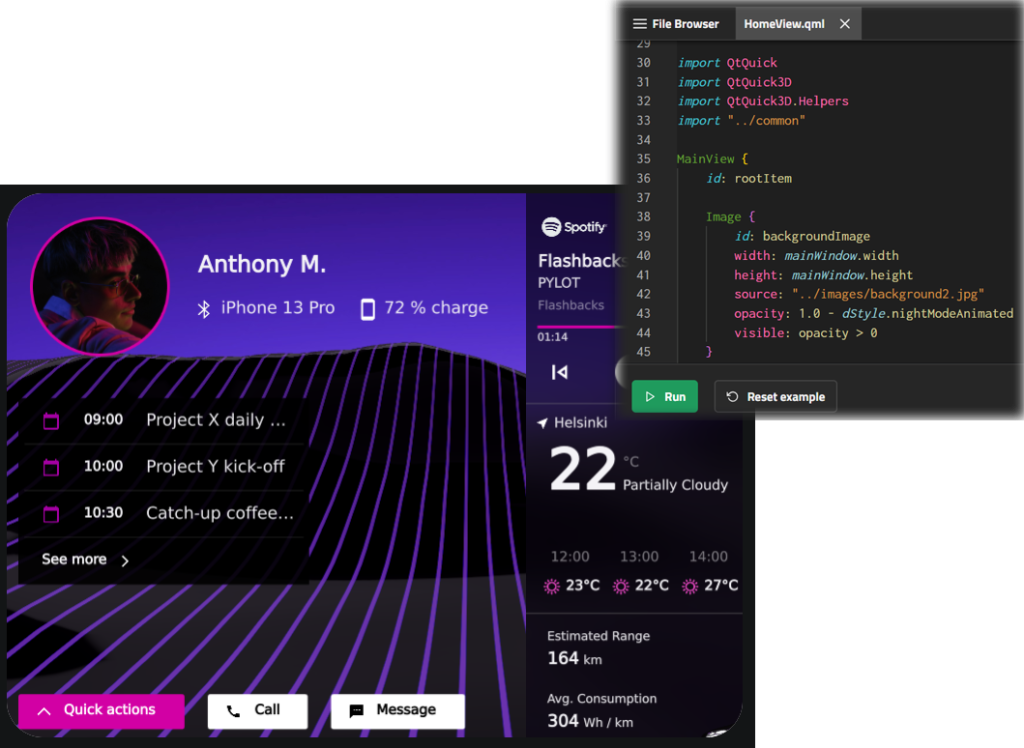
Qt enables development of applications using C++, QML, and integrated UI frameworks, supporting deployment across embedded and general-purpose systems.
Qt Creator
Integrated development environment (IDE) for Qt-based application development.
- Supports C++ and QML development
- Integrated debugging, testing, and deployment tools
- Cross-platform project management and build system integration
Qt Framework
A framework for structured application development across platforms.
Qt enables development of applications using C++, QML, and integrated UI frameworks, supporting deployment across embedded and general-purpose systems.
Qt Creator
Integrated development environment (IDE) for Qt-based application development.
- Supports C++ and QML development
- Integrated debugging, testing, and deployment tools
- Cross-platform project management and build system integration
Qt Framework
A framework for structured application development across platforms.
Qt enables development of applications using C++, QML, and integrated UI frameworks, supporting deployment across embedded and general-purpose systems.
Qt Creator
Integrated development environment (IDE) for Qt-based application development.
- Supports C++ and QML development
- Integrated debugging, testing, and deployment tools
- Cross-platform project management and build system integration
Your Development Journey With QT
Qt supports embedded systems development, HMI development, and real-time application interfaces across automotive, industrial, and medical domains.

Concept & Idea Plan
Define the core idea, user needs, and goals. Plan features, roadmap, and strategy to turn the vision into a clear, structured approach.

Design & Create UI/UX
Design layouts, branding, and visuals. Build user-friendly interfaces with smooth navigation and intuitive experience for better usability.

Development Code & Build
Convert designs into code using frontend and backend tools. Build features, test functionality, and ensure performance and stability.

Deploy Optimize & Launch
Deploy the product live, fix issues, and monitor performance. Optimize speed, gather feedback, and improve continuously for better results.

CI Pipeline Acceleration
Speed up software delivery lifecycle with higher reliability, intelligent caching, and parallelization and distribution.
End the issue of sluggish Kubernetes deployments by creating faster pipelines with smart caching strategies and reducing build time. Dynamic dependency tracking leads to reduced resource usage, optimization of costs, speedy iteration, and faster deployment.
CI Pipeline Acceleration
Speed up software delivery lifecycle with higher reliability, intelligent caching, and parallelization and distribution.
End the issue of sluggish Kubernetes deployments by creating faster pipelines with smart caching strategies and reducing build time. Dynamic dependency tracking leads to reduced resource usage, optimization of costs, speedy iteration, and faster deployment.